Stephen Colbert to End The Late Show TV Era as CBS Retires Franchise on May 21, 2026
By Anna Morris | Posted on April 06, 2026 12:01 PM
Stephen Colbert ends The Late Show TV run on May 21, 2026 as CBS retires the franchise amid ratings decline and Trump-era content shift.
CBS to End The Late Show Franchise as Stephen Colbert Signs Off
The Late Show with Stephen Colbert will conclude not just its current run, but the entire Late Show franchise, with CBS confirming it will retire the brand following Stephen Colbert’s departure.
Colbert debuted as host on September 8, 2015, succeeding David Letterman, whose final episode aired on May 20, 2015. CBS has confirmed that Colbert’s final episode will air on Thursday, May 21, 2026—almost exactly 11 years after Letterman signed off—bringing both his tenure and the franchise itself to a close.
From Entertainment to Political Centerpiece
When Colbert launched in 2015, CBS positioned the show as a broadly appealing, entertainment-first reboot. That approach shifted sharply after the November 8, 2016 election of Donald Trump.
By early 2017, Colbert—working with his writing staff and executive producers—pivoted decisively toward political commentary, making Trump and Washington the central focus of the nightly monologue. The move drew directly from Colbert’s prior satirical style and quickly reshaped the show’s identity.
The strategy delivered immediate results. By the 2017–2018 season, The Late Show was averaging around 3.1 million viewers per night, leading all of late night.

What Made Letterman’s Show Beloved
Much of the original appeal of The Late Show under David Letterman came from its unpredictability and distinctly New York flavor. The show thrived on absurd, low-stakes comedy that felt spontaneous rather than scripted.
Recurring bits like visits to Hello Deli with Rupert Jee, throwing objects off the Ed Sullivan Theater roof to see how they would smash, and man-on-the-street segments gave the show a sense of chaos and authenticity. Viewers didn’t just tune in for celebrity interviews—they tuned in to see what strange or pointless but hilarious idea Letterman would try next.
That style created a broad appeal. The humor was rarely political and often self-deprecating, allowing audiences across the spectrum to enjoy the show without feeling targeted or excluded.
By contrast, Colbert took the show in a more structured, monologue-heavy direction centered on topical commentary. While that approach resonated strongly with certain viewers, critics argue it lacked the unpredictability and lightness that made the Letterman era widely beloved, and at times felt more formulaic and less entertaining.
A Strategic Shift That May Have Narrowed the Audience
In hindsight, some industry observers argue the shift toward overt political commentary may have ultimately limited the show’s long-term appeal. While the focus on Trump drove short-term ratings gains, critics suggest it also alienated a significant portion of the potential audience.
That stands in contrast to Colbert’s earlier work on The Colbert Report, where his satirical persona allowed viewers across the political spectrum to feel in on the joke. On The Late Show, the tone became more direct and less character-driven, which some argue reduced that broader appeal and made the show more polarizing over time.
A Prolonged Feud with Trump—and Tensions with CBS
From 2017 through 2021, the show maintained a near-nightly focus on Trump, fueling an ongoing public feud. Trump repeatedly criticized Colbert publicly, while the show continued to target Trump’s presidency and political influence.
Behind the scenes, the show’s increasingly partisan tone created periodic friction with CBS executives. While the political focus initially boosted ratings, concerns grew over advertiser sensitivity and long-term audience erosion as viewers fragmented across platforms.
Ratings Decline and Cable Competition
Since its peak, The Late Show has seen a steady ratings decline. Recent seasons have averaged roughly 2.4 to 2.6 million viewers nightly, with about 220,000 to 230,000 in the 18–49 demo—down significantly from its highs.
At the same time, Gutfeld! on Fox News has emerged as an unlikely leader in total viewers, averaging approximately 3.3 million nightly viewers and around 240,000 in the demo. That puts the cable program ahead of Colbert by roughly 700,000 to 900,000 viewers per night.
The shift highlights a broader change in viewing habits, with lower-cost, opinion-driven cable formats increasingly outperforming traditional broadcast late night.
 Backlash Over Ending a Cash Cow
The decision has also sparked backlash within the industry, with some insiders and observers pointing to The Late Show as a long-standing revenue generator for CBS. Critics argue that Colbert’s evolution into a more politically driven host narrowed the audience and accelerated ratings erosion, ultimately contributing to the network’s decision to shut down the franchise entirely.
Others counter that broader industry trends—declining linear TV viewership and the rise of digital platforms—made the outcome inevitable regardless of the show’s direction.
Ticket Demand Collapses—Except for the Finale
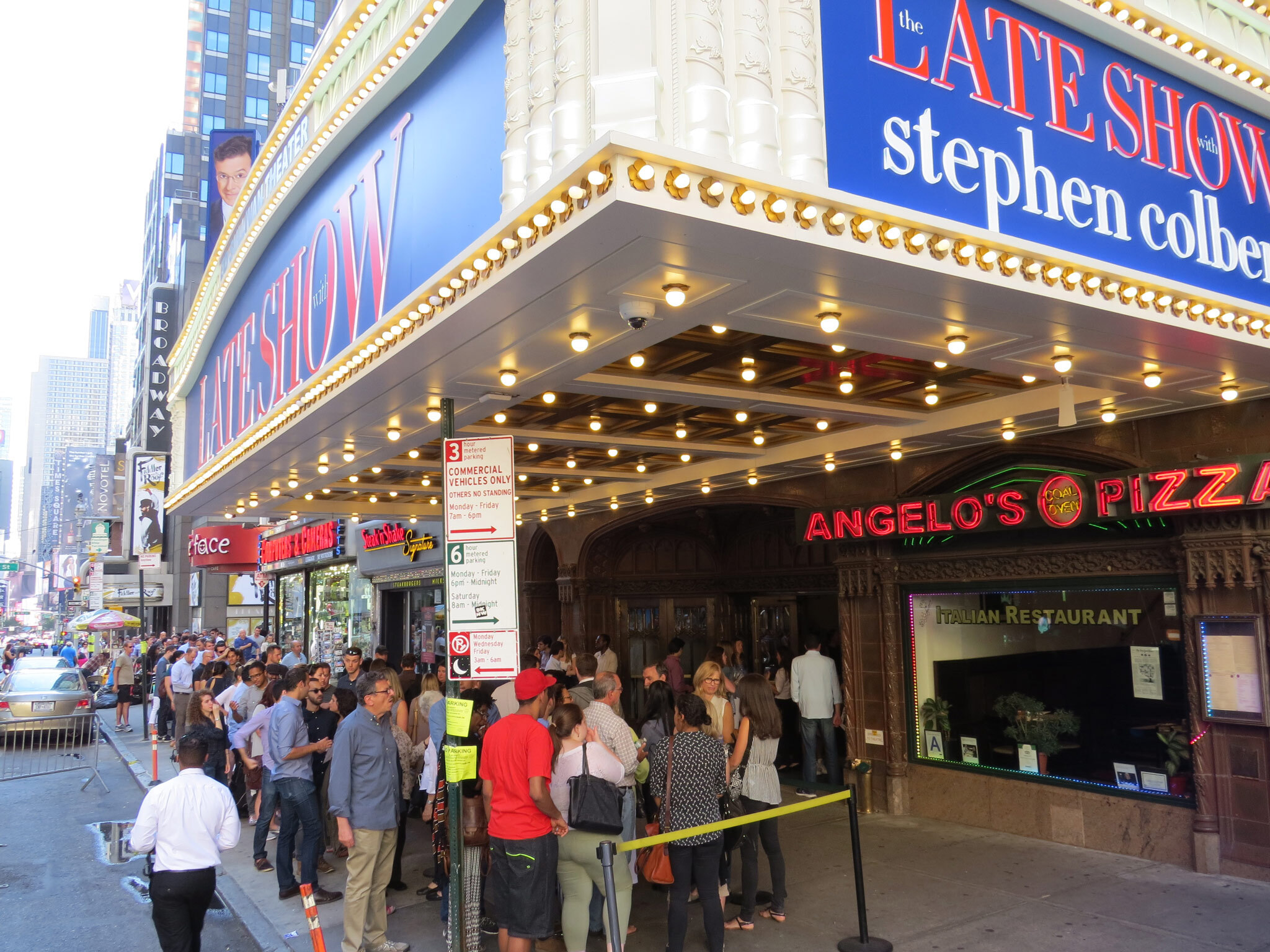
Audience demand for The Late Show tickets has followed the same downward trajectory as its ratings. In its earlier years—particularly during the post-2016 peak—tickets were in high demand, with long waitlists and standby lines stretching around the block.
More recently, however, the show has faced increasing difficulty filling seats for regular tapings, reflecting waning interest and a softer connection with live audiences. Industry observers note that it has become significantly easier to secure tickets compared to prior years, a stark contrast to the show’s peak popularity, especially the Letterman years.
That trend has reversed sharply for the final episode. With the May 21, 2026 broadcast now confirmed as the last, demand for tickets has surged, with the finale expected to be one of the most sought-after tapings in the show’s history (after Letterman of course)
The End of a Legacy—and What Happens to the Theater
The decision to retire The Late Show franchise marks the end of a program that began on August 30, 1993 with David Letterman and defined CBS late night for more than three decades.
Attention is now turning to the future of the Ed Sullivan Theater, the historic Broadway venue that has housed The Late Show since 1993. Industry speculation suggests CBS could sell the property to a major Broadway landlord, potentially returning the theater to its original use as a legitimate Broadway house staging live productions.
Such a move would mark a full-circle moment for the venue, which hosted live entertainment long before its late-night television era. A return to Broadway use would also be significant given the ongoing demand for large, well-located theaters in the district.
CBS has not confirmed a buyer or timeline, but the possibility underscores the broader shift away from traditional late-night infrastructure. Colbert’s final broadcast on May 21, 2026 will not just mark the end of a host’s run—it will close the book on one of network television’s most enduring late-night institutions, and potentially reopen a historic Broadway stage.